MCF7/182R-7 Cell Line
A human fulvestrant-resistant breast cancer model used to study acquired endocrine resistance, EGFR signalling, and combination therapies. Save 30% on this cell line this summer. Use code SUM26CELL at checkout.
Contributors
| Inventor | Institute |
|---|---|
| Anne Lykkesfeldt | Danish Cancer Society, Denmark |
| SKU: | 152106 |
|---|---|
| Product description: | The MCF7/182R-7 cell line is a human breast cancer cell line resistant to fulvestrant (Faslodex) that has been established from a clone of MCF7/S0.5 cells surviving long term growth with the pure steroidal antioestrogen ICI 182,780 (fulvestrant) at 100 nM concentration. MCF7/182R-7 cells express oestrogen receptor alpha and do not express progesterone receptor. Treatment with fulvestrant has proven effective upon progression on tamoxifen therapy and is now approved for second-line treatment after tamoxifen or aromatase inhibitors. As with tamoxifen treatment, patients eventually develop resistance to fulvestrant. This cell line can be used to study the molecular changes associated with acquired fulvestrant resistance, identify novel drug targets in resistant tumour cells and uncover biomarkers of therapy response. |
| Alternate name: | MCF-7/182R-7; 182R-7 |
| Gender: | Female |
| Production details: | The MCF7/182R-7 cell line has been established from a clone of MCF7/S0.5 cells surviving long term growth with the pure steroidal antiestrogen ICI 182,780 in 100 nM concentration, Lykkesfeldt et al (1995). The MCF7/182R-7 cells can be maintained continuously in growth medium with 100 nM fulvestrant. |
| Additional notes: | Upon withdrawal of fulvestrant, the cells express ER alpha, although at a reduced level. The MCF7/182R-7 cells do not express progesterone receptor. The MCF7/182R-7 cells express increased level of EGFR, phosphorylated EGFR and phosphorylated ErbB3 and reduced level of ErbB4 compared to the parental MCF7/S0.5 cells. |
| Cellosaurus ID: | CVCL_1D41 |
| Parental cell line: | MCF7 S0.5 |
| Disease: | Cancer |
| Cat. #: | 152106 |
|---|---|
| Tool sub type: | Continuous |
| Unit size: | 1×10^6 cells / vial |
| Cancer types: | Breast cancer |
| Organism: | Human |
| Tissue: | Breast |
| Gender: | Female |
| Model: | Cancer cell line |
| Growth properties: | Adherent |
| Primary citation: | Lykkesfeldt et al. 1995. Int J Cancer. 61(4):529-534. PMID: 7759159. |
| Format: | Frozen |
|---|---|
| Shipping conditions: | Dry ice |
| Growth medium: | Phenol red free DMEM/F12 (1:1) supplemented with 1% FCS, Glutamax 2.5 mM and 6 ng/ml insulin. Supplemented with 100nM fulvestrant to maintain resistance. |
| Subculture routine: | After thawing, dilute the cell suspension with sufficient medium and distribute 5 mL each into T25 flasks to achieve a seeding density of 0.5-1.0 x 10^4 / cm2. Place in a 37°C, 5% CO₂ incubator. Change medium after 24 hours to remove residual DMSO and then every 2-3 days. Subculture routine: Split 1:30 weekly with Trypsin-EDTA for detachment at 37 °C for 5 minutes. Please also see detailed protocol within the Product Datasheet in the Documentation tab. |
| Temperature: | 37° C |
| Atmosphere: | 5% CO2 |
| Storage medium: | 10% DMSO in FCS. |
| References: |
Thrane et al. 2014. Oncogene. 34(32):4199-4210. PMID: 25362855. Frogne et al. 2009. Breast Cancer Res Treat. 114(2):263-275. PMID: 18409071. Frankel et al. 2007. Breast Cancer Res Treat. 104(2):165-179. PMID: 17061041. Frogne et al. 2005. Endocr Relat Cancer. 12(3):599-614. PMID: 16172194. Christensen et al. 2004. Breast Cancer Res Treat. 85(1):53-63. PMID: 15039597. Larsen et al. 1997. Int J Cancer. 72(6):1129-1136. PMID: 9378550. Lykkesfeldt et al. 1995. Int J Cancer. 61(4):529-534. PMID: 7759159. |
|---|
Images
View Gallery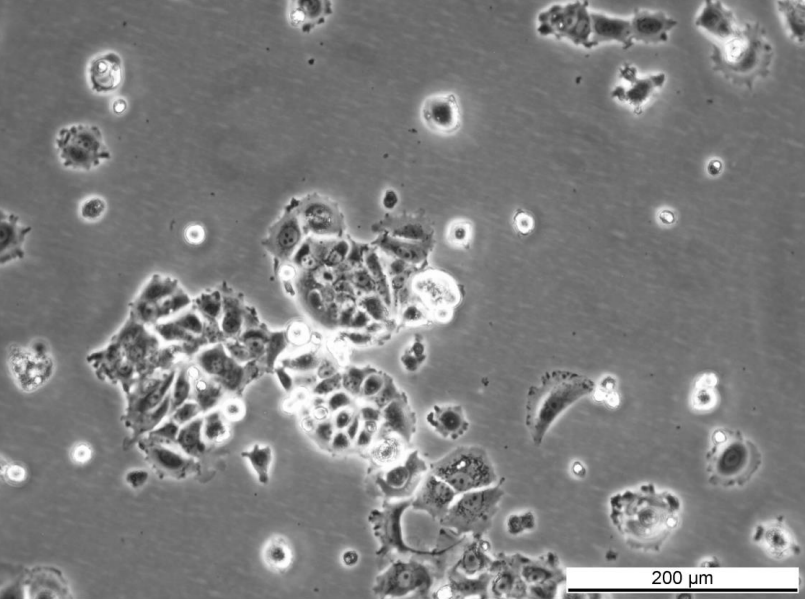
Product Images
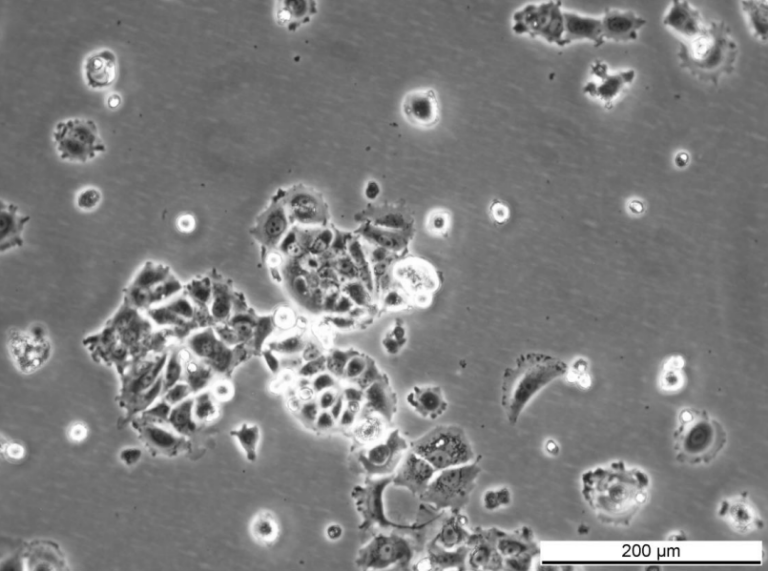
MCF7 182R-7 Cell Line. Early log phase
MCF7 182R-7 Cell Line. Early log phase. Image courtesy of the European Collection of Authenticated Cell Cultures (ECACC), UK.
 Powered by Bioz